
Quels sont les types de tuyaux en PEHD ?
An Overview of Major High-Density Polyethylene Piping Classifications
Les tuyaux en polyéthylène haute densité (PEHD) sont devenus un matériau de tuyauterie incontournable pour les réseaux municipaux et les services publics. Mais qu'est-ce qu'un tuyau en PEHD exactement et qu'est-ce qui le distingue des autres tuyaux en plastique ou en métal ? Cet article examine le PEHD afin de comprendre ses capacités et pourquoi il est préconisé pour les projets de tuyauterie modernes.Usine IFAN avec plus de 30 ans d'expérience dans la fabrication, prend en charge la personnalisation des couleurs/tailles et des échantillons gratuits. Bienvenue pour consulter pour catalogue et échantillons gratuits.Voici notre site Web Facebook : +.
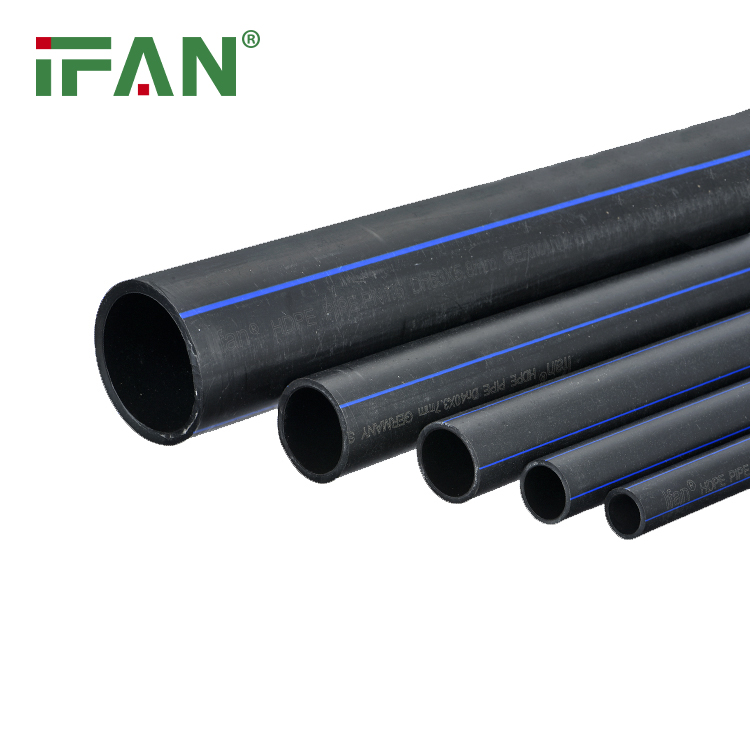
HDPE Solid Wall Pipe
Solid wall HDPE pipe provides the standard for durable piping across sizes from 1⁄2” to 65”. It meets engineering requirements for:
- Municipal and utility water mains and distribution piping
- Industrial plant process piping
- Sewer force mains and large drainage conduits
- Landfill gas and leachate collection
- Slurry and chemical pipelines
- Agricultural irrigation channels
Fabricated from virgin HDPE resin, extruded and butt welded, solid wall HDPE demonstrates unmatched corrosion resistance and toughness for long service.
HDPE Profile Wall Pipe
Profile wall HDPE reduces weight while maximizing stiffness. The inner wall stays smooth while the exterior has ribs or hollow channels along its length. The profiles provide rigidity under bury and loading conditions.
Profile wall HDPE finds use for:
- Trenchless installations like horizontal directional drilling where pipe must bear installation forces
- Piping across unstable soils prone to shifting or settling
- Deep installations subject to significant overburden pressures
- Large diameter piping where wall thickness and weight need reduction
Profile wall HDPE retains the same joint integrity, chemical resistance, and flow characteristics as solid wall HDPE while enabling large diameters with reduced material.
HDPE Corrugated Pipe
HDPE corrugated pipe provides lightweight, flexible piping for non-pressure drainage applications. The exterior corrugations allow pipe flexure and elongation while preventing collapse.
Key uses of HDPE corrugated pipe are:
- Culverts and storm sewer conduits
- Low-pressure sanitary sewer mains and lateral connections
- Pipeline protection sleeves where flexibility matters
- French drains and agricultural drainage tiles
- Residential generator exhaust and venting
Corrugated construction allows the production of large HDPE pipes with thin walls in long sections, reducing installation labor.
HDPE Perforated Pipe
Perforated HDPE provides subsurface drainage for infrastructure and agriculture. The perforations allow water ingress while the smooth interior maintains flow rates.
Applications of perforated HDPE pipe encompass:
- Foundation barrier drainage collection
- Highway edge and pavement subsurface drainage
- Landfill leachate collection
- Golf course drainage beneath greens and fairways
- Agricultural field tile drainage
- Wick wells and infiltration trenches
Perforations get formed during HDPE pipe extrusion. Their size and spacing can get customized to required drainage rates.
Specialty HDPE Pressure Pipe
In addition to standard HDPE pressure pipe, some special designs suit unique installation requirements:
- Restrained joint HDPE withstands pipeline thrust forces where changes in direction occur.
- Flexible HDPE remains bendable to snake within pre-existing pipe paths during slip-lining rehab and renovation projects.
- Narrow-width HDPE allows insertion through congested utility corridors with limited clearance.
- Insulated HDPE maintains consistent fluid temperatures across long piping networks.
- Steel-reinforced HDPE gains added collapse resistance for empty pipe testing and LCD installations.
These specialty HDPE pipes expand the range of applications able to utilize HDPE’s fundamental strengths.
HDPE Pipe Standardization
HDPE pipe types follow standardized sizing, rating, and joining criteria defined by organizations like ANSI, ASTM, and ISO. This enables engineering and specifying HDPE piping for compliance with regulatory approvals and codes.
With its diversity, HDPE continues meeting new challenges and replacing outdated piping materials across essential civil and industrial needs. The ongoing evolution of HDPE pipe enables serving ever broader piping system demands.
IFAN
L'usine IFAN a démarré en 1993. Et IFAN dispose d'un atelier de 120 000 mètres carrés avec 610 employés. IFAN peut concevoir et produire tous les tuyaux et raccords de plomberie, y compris les tuyaux et raccords PPR, PVC, CPVC PPSU HDPE PEXA PEXB PERT, les raccords en laiton, les robinets à boisseau sphérique en laiton, les systèmes de chauffage, les systèmes de gaz, les robinets sanitaires et les tuyaux. Au cours des 30 dernières années, IFAN n'a jamais oublié sa mission : protéger la santé et la sécurité. Et l'usine IFAN utilise les meilleurs matériaux pour produire des tuyaux et raccords de haute qualité avec une ligne de production automatique et des machines de contrôle qualité de haute technologie.